Home
TreeDivNet
TreeDivNet is an international platform for research on the relation between tree species diversity and ecosystem
functioning. The network groups several research projects in different parts of the world and forms the largest project on
ecosystem research worldwide. In total, over 660 000 trees were planted in the thirteen research projects on a total surface of
more than 700 ha.
For a short and easy-reference presentation of the network TreeDivNet, we refer to the
publication
in International Innovation. International Innovation is the leading global dissemination resource
for the broader science, technology and research communities, dedicated
to disseminating the latest science, research and technological
innovations on a global level. More information and a complementary
subscription offer to the publication can be found at: researchmedia.eu

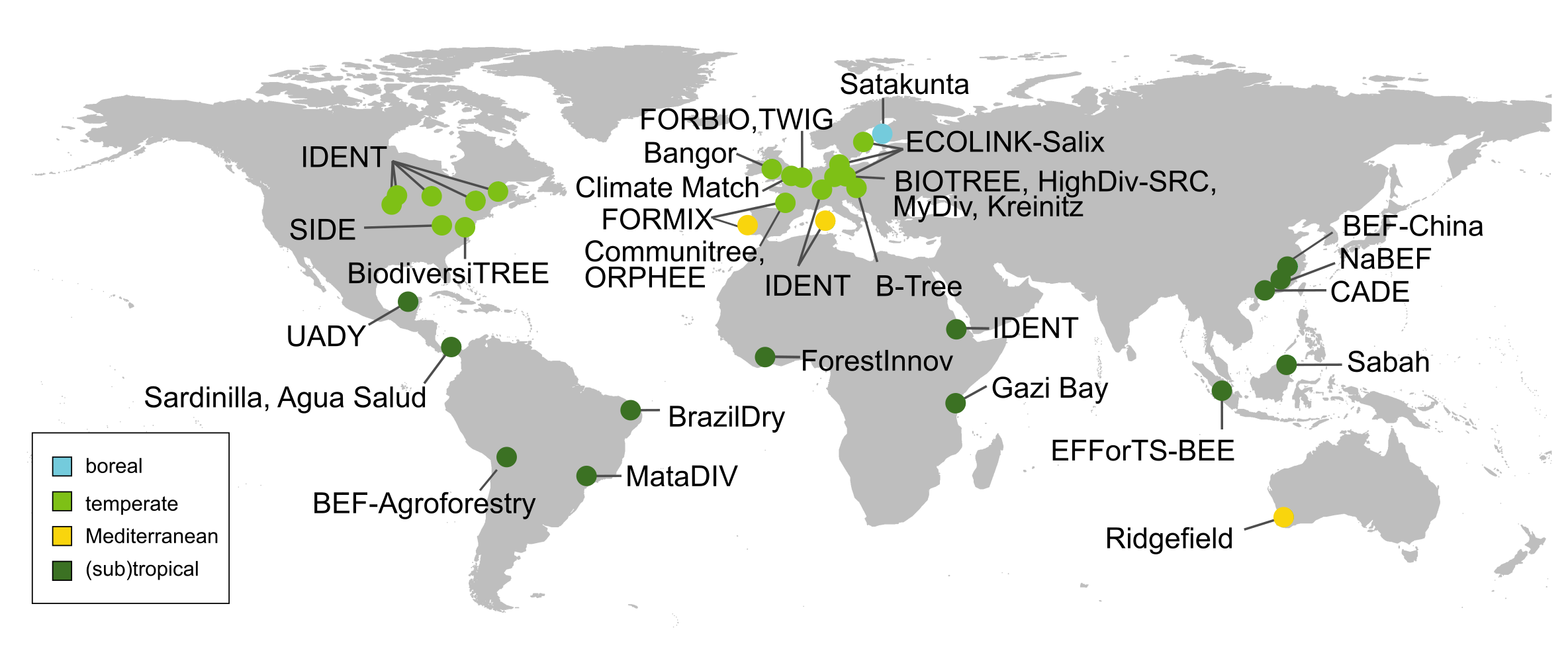
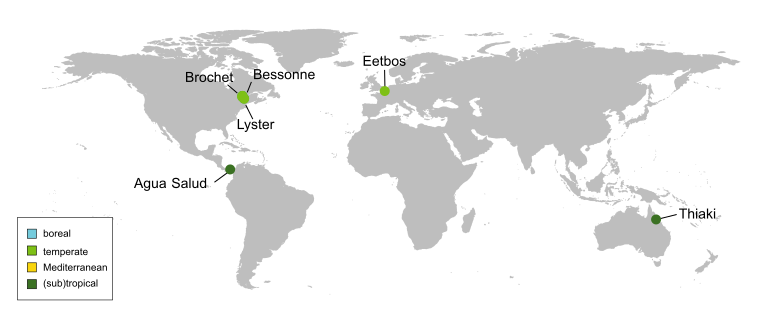
Location of the 13 research projects that make up the TreeDivNetwork, the largest project on ecosystem research worldwide.
| Site | Plant year | No of exp. | Plot size (ha) | No of plots | Diversity variables | Diversity gradients |
|---|---|---|---|---|---|---|
| BEF-China | 2009 | 1 | 0.02 - 0.27 | 271 | Species richness Shrub species richness |
0, 1, 2, 4, 8, 16 sp. 0, 4, 8, 16 shrub sp. |
| BIOTREE | 2003/2004 | 2 | 0.2 - 1.2 | 81 | Species richness Functional diversity |
1, 2, (3) 4, 6 (10) sp. FD Gradient |
| Communitree | 2009 | 1 | 0.24 m2 | 90 | genetic diversity genetic relatedness among individuals |
1,2,3,4 half-sib families |
| FORBIO | 2010/2012 | 3 | 0.13-0.18 | 127 | Species richness Genetic diversity |
1, 2, 3, 4 sp. Quercus robur, Fagus sylvatica |
| Gazi Bay | 2004 | 1 | 0.0036 | 32 | Species richness | 1, 2, 3 sp. |
| IDENT | 2009-2012 | 1 | 0.75 | 216 | Species richness ID of functional groups |
1, 2, 4, 6, 16 sp. 8 levels of FD |
| Kent | 2011 | 3 | 0.014 - 0.13 | 84 | Species richness Genetic diversity |
1, 2, 3 sp. 1, 2, 3 provenances |
| Kreinitz | 2005 | 1 | 0.0025 | 98 | Species richness ID of functional groups |
0, 1, 2, 3, 5, 6 sp. decid./conif., decomp. |
| ORPHEE | 2008 | 1 | 0.04 | 256 | Species richness ID of functional groups |
1, 2, 3, 4, 5 sp. decid./evergr., phenol. |
| Ridgefield | 2010 | 1 | 0.05 | 124 | Species richness Functional richness |
0, 1, 2, 4, 8 sp. 0, 1, 2, 3, 4 FR levels |
| Sabah | 2010 | 1 | 4.0 | 124 | Species richness No. of generea Tree height |
1, 4, 16 sp. 2 vs. 4 genera 2 vs. 3 height classes |
| Sardinilla | 2001/2003 | 2 | 0.03 - 0.2 | 32 | Species richness ID of functional groups |
1, 3, 6 + 6, 9, 16 sp. pioneer - shadetol. |
| Satakunta | 1999 | 2 | 0.04 | 114 | Species richness No. of functional groups Gen. div. Betula pendula |
1, 2, 3, 5 sp. decid./conif./mix 1, 2, 4, 8 clones |
Summary of the research projects that make up the TreeDivNet network.
History
Forest management has been evolving for centuries. Striving for
productivity and simplicity, managed forests were often transformed to monocultural stands during the industrial revolution.
With the introduction of the concept of sustainability, the interest for mixed stands revived in the last decennia.
Important questions arose in forest research:
Are mixed forests more productive than monocultures? Do they have a better regulation of energy, water and material fluxes?
Are they more resistant to disturbances and pest outbreaks? Do they allow a higher biodiversity of associated species?
These questions have puzzled forest ecologists for a long time now. Yet unequivocal answers on the ecological effects of
mixing tree species have not been formulated up till now, due to the lack of a rigorous conceptual framework.
In the last decades, several research projects have been established worldwide to investigate the relation between
forest/tree biodiversity and ecosystem functioning. These projects exist of experimental sites with planted forest communities
with varying tree species diversity. In the future ecosystem functioning between plots with a different tree species diversity
but with similar site characteristics will be evaluated.
The TreeDivNetwork groups all these similar research projects. Through cooperation, the research and related communication
can be more powerful. The outcome of this research could influence the future of forest management worldwide.

    View on one of the older sites of the TreeDivNet network: the Sardinilla site in Panama (2005).